





Are Homemade Raw Dog Food Recipes Safe for Your Dog?
Table of Contents
- Why Are Pet Parents Interested in DIY Raw Dog Food Recipes?
- What Is the Time and Cost Commitment for DIY Raw Feeding?
- What Should You Consider When Sourcing Meat?
- Should You Process Meat in a DIY Raw Diet?
- What Is an Example Raw Dog Food Recipe?
- What Is the Science of a Balanced Raw Diet?
- What Is the 80/10/10 Rule and What Are Its Limitations?
- Is There a Risk of Nutritional Imbalance With DIY Raw Dog Food Recipes?
- Is Homemade Raw Dog Food Safe?
- What Is the We Feed Raw Safety Advantage?
- Why Choose We Feed Raw as an Alternative to DIY Raw Dog Food?
- Frequently Asked Questions
Homemade raw dog food recipes require a precise balance of raw muscle meat, organs, and bone to provide a canine with complete daily nutrition. While understanding that raw food is good for dogs, formulating these meals at home carries substantial risks of severe nutrient imbalances and pathogen exposure.
Utilizing an expert-formulated, pre-made meal plan eliminates the dangerous guesswork of a DIY approach while ensuring absolute nutritional safety.
Why Are Pet Parents Interested in DIY Raw Dog Food Recipes?
Pet parents are interested in DIY raw dog food recipes because they want complete control over their pet's ingredients and wish to avoid the heavy processing associated with commercial kibble.
Preparing a fresh, homemade meal offers the satisfaction of choosing custom cuts, which is particularly appealing for owners managing specific canine food allergies or severe sensitivities. Many people also firmly believe that a meal prepared from scratch in their own kitchen is inherently fresher than a store-bought alternative.
What Is the Time and Cost Commitment for DIY Raw Feeding?
The time and cost commitment for DIY raw feeding is exceptionally high, requiring significant financial investment and hours of weekly kitchen labor. What often begins as a well-intentioned idea can quickly transform into an exhausting and complicated undertaking.
The daily reality of managing a homemade raw diet involves multiple logistical demands:
•Sourcing: Sourcing the correct ingredients is difficult. It is not enough to just buy ground beef. You must find reputable suppliers for fresh muscle meat, a variety of organ meats (like liver, kidney, and spleen), and raw meaty bones, all of which can be challenging to find and expensive to purchase individually.
•Preparation: Preparing the meals is a time-consuming process. It involves grinding meat, chopping organs, carefully measuring everything to the right ratios, and then portioning each meal into freezer-safe containers.
•Storage: A significant amount of freezer space is necessary. Storing multiple weeks' worth of meat, bones, and pre-made meals requires careful organization and a large freezer, which many homes do not have.
What Should You Consider When Sourcing Meat?
When sourcing raw meat for dogs, you must look beyond the standard grocery store aisle to find diverse organ varieties and economical bulk pricing.
Consider these places when you source your ingredients for homemade raw dog food recipes:
•Butchers: Local butchers often sell meat scraps, organ meat, and raw meaty bones at a lower cost than prime cuts. You can also form a relationship with a butcher who may be willing to save specific parts for you.
•International Markets: These markets frequently offer a wider variety of organ meats (such as tripe, spleen, and hearts) that are harder to find at a conventional supermarket.
•Bulk Stores: Warehouse clubs like Costco and Sam's Club can be a great place to buy large quantities of muscle meat, such as beef or chicken, at a lower price per pound.
•Local Farms: Some small farms sell directly to the public. You can often purchase a portion of a cow or pig from a farm, which can provide you with a variety of cuts at a lower cost.
Should You Process Meat in a DIY Raw Diet?
You should process meat in a DIY raw diet by grinding it if your dog is small, elderly, or prone to gulping large chunks of food without chewing.
Whole raw meaty bones provide an excellent mental workout and natural dental scrubbing benefits for dogs with safe chewing habits. However, owners must carefully supervise mealtime to prevent choking or internal punctures.
For sensitive or senior canines, investing in heavy-duty grinding equipment removes bone-related safety risks entirely while keeping the nutritional benefits of the raw diet intact.
What Is an Example Raw Dog Food Recipe?
An example raw dog food recipe uses basic percentages to distribute muscle meat, organs, and bone, though a true ancestral meal requires additional micronutrient adjustments.
A single simplified meal for an adult dog typically follows a foundational breakdown:
•80% Muscle Meat: A mixture of chicken thighs and ground beef
•10% Organ Meat: A small piece of chicken liver and beef kidney
•10% Ground Bone: A finely ground chicken back
This meal provides a good ratio of muscle meat, organs, and bone, but it is not necessarily nutritionally complete on its own. For a truly balanced diet, you would need to vary the proteins and add essential supplements to fill any remaining nutritional gaps.
It is this complexity that makes the pre-formulated approach of a brand like We Feed Raw a more reliable and safer option for most pet owners.
What Is the Science of a Balanced Raw Diet?
The science of a balanced raw diet centers on precise macro and micronutrient synergy, making nutritional imbalance a far greater hazard than pathogens.
Renowned PhD animal nutritionist Dr. Richard Patton emphasizes that a meal which looks physically satisfying can still be completely deficient at a cellular level: "The closer a diet resembles what nature intended, the less work the body has to compensate for nutritional mistakes."
What Is the 80/10/10 Rule and What Are Its Limitations?
The 80/10/10 rule is a basic ratio guideline for raw feeding, but its primary limitation is that it fails to guarantee complete trace mineral and vitamin accuracy.
While combining 80% muscle meat, 10% organ meat, and 10% bone serves as a functional starting point, relying on it blindly causes severe long-term deficiencies. For instance, a homemade recipe constructed strictly from chicken breasts, chicken bones, and chicken liver will completely lack vital levels of zinc, copper, manganese, and iodine.
Is There a Risk of Nutritional Imbalance With DIY Raw Dog Food Recipes?
Yes, there is an immense risk of nutritional imbalance with DIY raw dog food recipes if the precise calcium-to-phosphorus ratio is miscalculated. Feeding a diet that is bone-heavy or bone-light can result in severe, irreversible skeletal deformities, which is especially dangerous for growing large-breed puppies.
To achieve genuine biological completeness, you must carefully weave in a wide variety of secreting organs from multiple distinct animal species to build a safe, full-spectrum vitamin profile.
What Is the Role of Supplements in DIY Raw Dog Food?
The role of supplements in DIY raw dog food is to bridge the unavoidable nutritional gaps that plain whole meats cannot satisfy on their own.
Even when following accurate muscle-to-bone percentages, critical trace elements remain missing from standard agricultural meats. To build a complete profile, homemade plans routinely require the addition of omega-3 fatty acids, zinc, iodine, and vitamin E.
Reflecting on the challenge of balancing these gaps, Dr. Richard Patton notes: "It's hard to correct a poor diet with supplements. You must first fix the food itself."
Is Homemade Raw Dog Food Safe?
No, homemade raw dog food prepared with standard supermarket meat carries a high risk of bacterial contamination because grocery store cuts are legally processed with the expectation that they will be thoroughly cooked.
Standard food safety supply chains do not manage raw meats with raw pet consumption in mind. Furthermore, prepping raw poultry or beef in a standard home kitchen increases the danger of cross-contamination across countertops, utensils, and storage bins.
What Is the We Feed Raw Safety Advantage?
The We Feed Raw safety advantage delivers a level of pathogen protection that is completely impossible to match in a home kitchen.
We eliminate raw feeding risks through strict commercial safety protocols, including:
•High-pressure processing: We use a cold-pressure process known as high-pressure processing (HPP) on all our raw recipes. This advanced technology uses intense water pressure to inactivate pathogens without heat, ensuring the food is safe from bacteria and viruses.
•USDA-certified facility: We produce our food in a USDA-certified facility that meets the same high-quality standards as those that handle human food. This strict adherence to cleanliness and safety protocols eliminates the risks inherent in a home kitchen.
•Pre-portioned and safely packaged: Our meals come pre-portioned and safely packaged, so you never have to worry about cross-contamination in your kitchen. You simply thaw and feed.
Why Choose We Feed Raw as an Alternative to DIY Raw Dog Food?
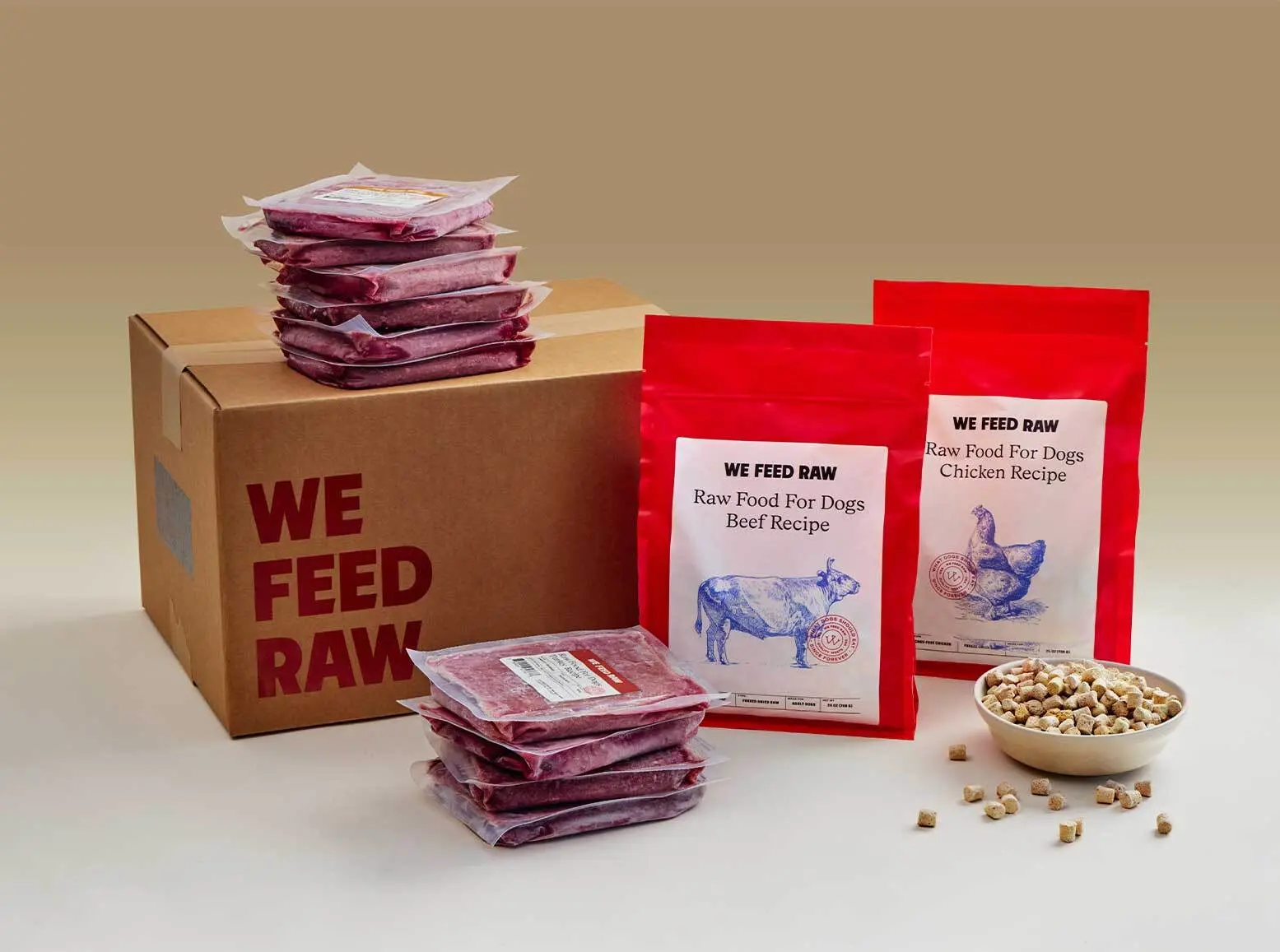
You should choose We Feed Raw as an alternative to DIY raw dog food because we handle the intense labor, sourcing logistics, and nutritional math for you, delivering all the life-changing benefits of fresh food with none of the stress. Our frozen raw recipes provide completely balanced meals that are ready to thaw and serve cleanly.
For adult dogs, we also offer premium freeze-dried raw recipes that provide shelf-stable pantry convenience without requiring freezer space. By trusting recipes formulated by a PhD animal nutritionist to exceed AAFCO guidelines, you can ensure your canine companion thrives safely.
Take our online quiz today to set up your dog's custom meal plan.
Frequently Asked Questions
What are the biggest risks of using homemade raw meat recipes for dogs?
The biggest risks of using homemade raw recipes are nutritional imbalance and pathogen contamination. Without a deep understanding of canine nutrition, it is easy to create a diet that is deficient in key vitamins, minerals, and the proper calcium-to-phosphorus ratio.
Additionally, preparing raw meat from the grocery store at home carries a risk of pathogens and cross-contamination.
Do DIY raw dog food recipes require supplements to be nutritionally complete?
Yes, most DIY raw dog food recipes require supplements to be truly nutritionally complete. While the 80/10/10 ratio of muscle meat, organs, and bone is a good starting point, it often lacks essential nutrients that dogs need.
Pet parents typically need to add supplements like omega fatty acids, zinc, and iodine to ensure a complete and balanced diet, which is a key reason why professionally formulated raw food is a much safer option.
How do you ensure the safety of bones in a DIY raw dog food recipe?
When using bones in a DIY raw dog food recipe, safety is paramount. You should only use raw meaty bones and avoid cooked bones, which can splinter.
Select bones that are the appropriate size for your dog's jaw and chewing style. Grinding meat and bone together is another option for dogs who are not suited for chewing whole bones.
How does a commercial raw diet compare to DIY raw dog food recipes in terms of convenience?
A commercial raw diet offers a level of convenience that DIY raw dog food recipes cannot match. A company like We Feed Raw handles all the sourcing, grinding, and portioning for you. The recipes are delivered frozen, pre-portioned, and are ready to thaw and serve, saving you hours of preparation time and the hassle of sourcing and storage.
Our Meals Change Lives.
(Theirs + Yours.)
See health improvements from our raw meals in as little as 1 week.


